World
Timeline of the Throne in Exile
A reader's timeline placing the events of Travesty and the Throne in Exile series within the closing years of Treta Yuga, without revealing story outcomes.
The Age of Treta Yuga
The second of the four ages.
Dharma stands on three legs, not four. The world is still largely ordered, but cracks have begun to show—in the courts, in the forests, and in the compacts between peoples who once shared the same rivers.
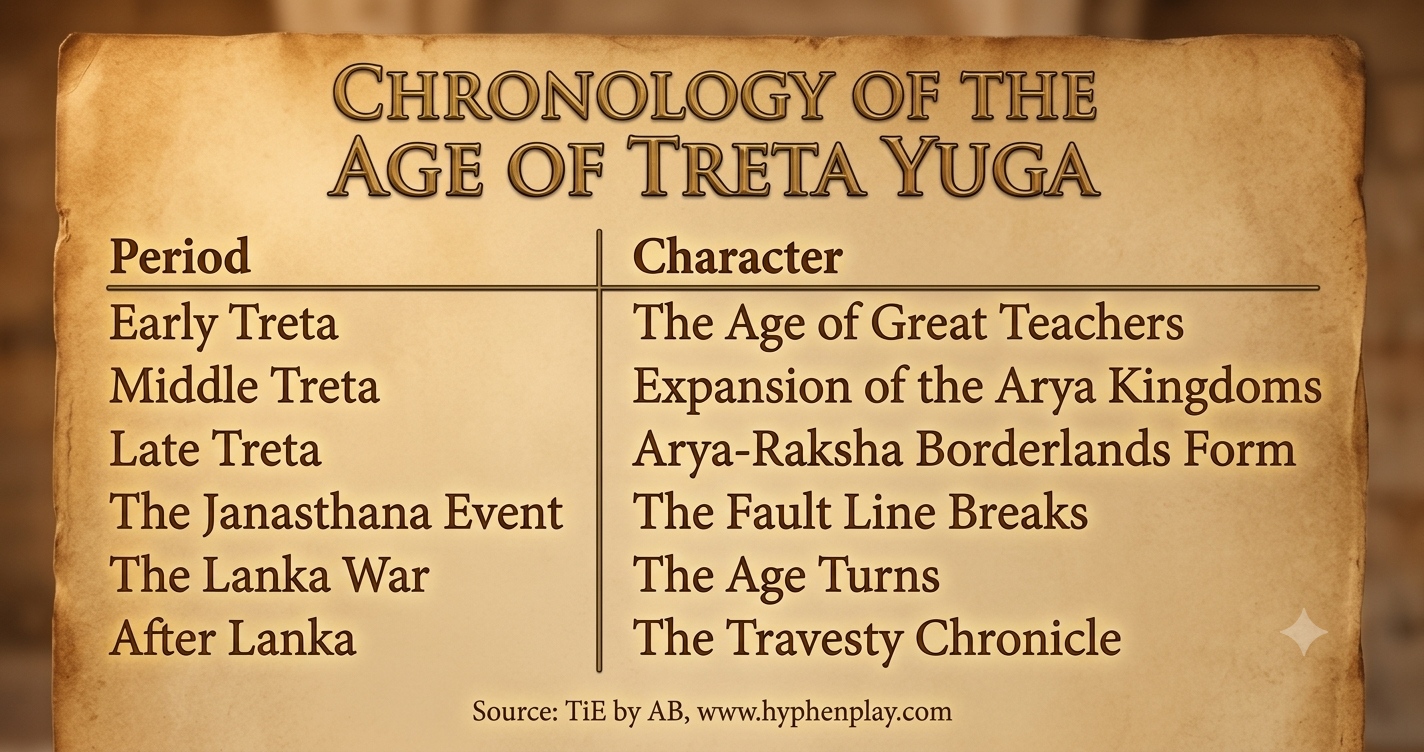
| Period | Character | Summary for the Reader |
|---|---|---|
| Early Treta | The Age of Great Teachers | Ashrams multiply. The forest is still primarily a place of learning, not exile. |
| Middle Treta | Expansion of the Arya Kingdoms | The Kuru-Panchala heartland consolidates. Videha remains distinct: more democratic, more questioning. |
| Late Treta | Arya-Raksha Borderlands Form | Dandaka becomes contested territory. Janasthana reaches its northernmost extent. |
| The Janasthana Event | The Fault Line Breaks | Fourteen thousand dead. The chain of consequence that drives everything in this chronicle begins here. |
| The Lanka War | The Age Turns | The war ends. The harder story begins. |
| After Lanka | The Travesty Chronicle | Sarama begins writing. |
For Serious Readers who want to extend this
This timeline offers a safe chronological guide without ruining the story’s big emotional twists. A Treta Yuga timeline can be spoiler-safe if it stays at the age level rather than the narrative event level — so this describes the era’s character, not what happens to specific characters.
This structure works because it positions the reader temporally without revealing what any character chooses or suffers. The Janasthana entry is the only narrative-adjacent one, but it is already disclosed in the Travesty glossary — it is backstory, not spoiler.
The principle: events become safe when they are causes, not consequences. The timeline cannot say what Sita decided at the end of Book 1 — that is a consequence, still unread for new visitors.