Why this retelling of the Ramayana was written.
Why This Chronicle?
This note seeks to explain why this retelling exists and what it asks of its reader.
A Note to the Reader on tone and intent — Across every version of the Rāmāyaṇa, Rāma is remembered as the ideal man, and there is good reason for this. He performed a thousand acts of good, and his moral character, examined across the whole of his life, was consistently strong. This chronicle explores one difficult chapter of that life with honesty. It does not ask the reader to forget the rest.
The Vālmīki Rāmāyaṇa is a textual composition, fixed in verse, transmitted and studied across centuries. The Rāmāyaṇa tradition is something else. It is a living, expanding conversation, a cultural mirror that each generation of writers has picked up and turned toward its own concerns. Kamban did this (emphasising emotional storytelling). Tulsidas did this (introducing Māyā Sītā). The oral tellers of the Rāmkaṭhā, particularly the women’s songs of the fire trial and the exile, did this long before any of it was written down. This chronicle belongs to that second category. It does not claim to replace the Vālmīki text. It asks to sit alongside it.
A counternarrative, offered in this spirit, does not erase the original. It completes it by complementing it. Rama’s story is not fully told without a close study of Sita, of how she moved through a world with its own codes of duty and honor, its own demands of statecraft. Valmiki’s own dialogues show her asking a hard question of the killing of the Rakshasa tribe, how this can be called dharma. That question deserves to be followed rather than passed over, and this chronicle tries to follow it.
The lens for that following is Sarama. She is Sita’s confidante, and she writes as a chronicler rather than an advocate. Her instinct is toward tragic realism, not toward blame. Where the reader might expect a villain, she tends to find a person trapped inside an office they cannot resign from. This is deliberate. A story told through her eyes does not ask whether Rama was good or bad. It asks what a fire trial looks like from the ground, when it is public gossip rather than settled fact that is dictating the policy of a state.
Read this way, the material grows more tragic rather than less. If Rama secretly knew of her innocence, and yet the demands of his own kingship required him to sit as judge in a trial he understood to be hollow, then his position is not villainy. It is closer to imprisonment, a man made to enforce a law he privately doubted, on behalf of a state that Agastya, in the text, is shown to embody and defend. The fire trial becomes something closer to political theater, staged to satisfy a crowd, than to justice. A system that requires an innocent person to be broken, publicly and repeatedly, to prove a point already known to be true, is a system with something wrong at its center. This chronicle is interested in naming that wrongness plainly, without turning the man who enacted it into a caricature.
None of this is new to the tradition. Medieval tellings that introduced the device of the Maya Sita, the shadow-double left in Ravana’s captivity while the true Sita remained hidden and unharmed, exist for a reason close to this one. Valmiki’s own dialogues, read carefully, already carry the suggestion that a travesty of justice took place on the shores of Lanka. This retelling does not invent that discomfort. It inherits it and asks a modern reader to sit with it.
I am hopeful that a young reader encountering this counter-perspective will not come away with a diminished view of the epic. The opposite seems more likely. Being introduced early to a text that argues with itself is, I think, the more faithful introduction to Indian philosophy, which has never been a tradition of settled answers. It sharpens the reader’s own thinking rather than softening it.
Volumes 0, 1, and 2 are original, non-canonical works inspired by the Rāmāyaṇa, reimagining its characters and events through the long transition from itihāsa to history.
- Volume 0 — Travesty (This site)
- Volume 1 — Heartbreak (Published book, with ISBN)
- Volume 2 — Exodus (Book in progress)
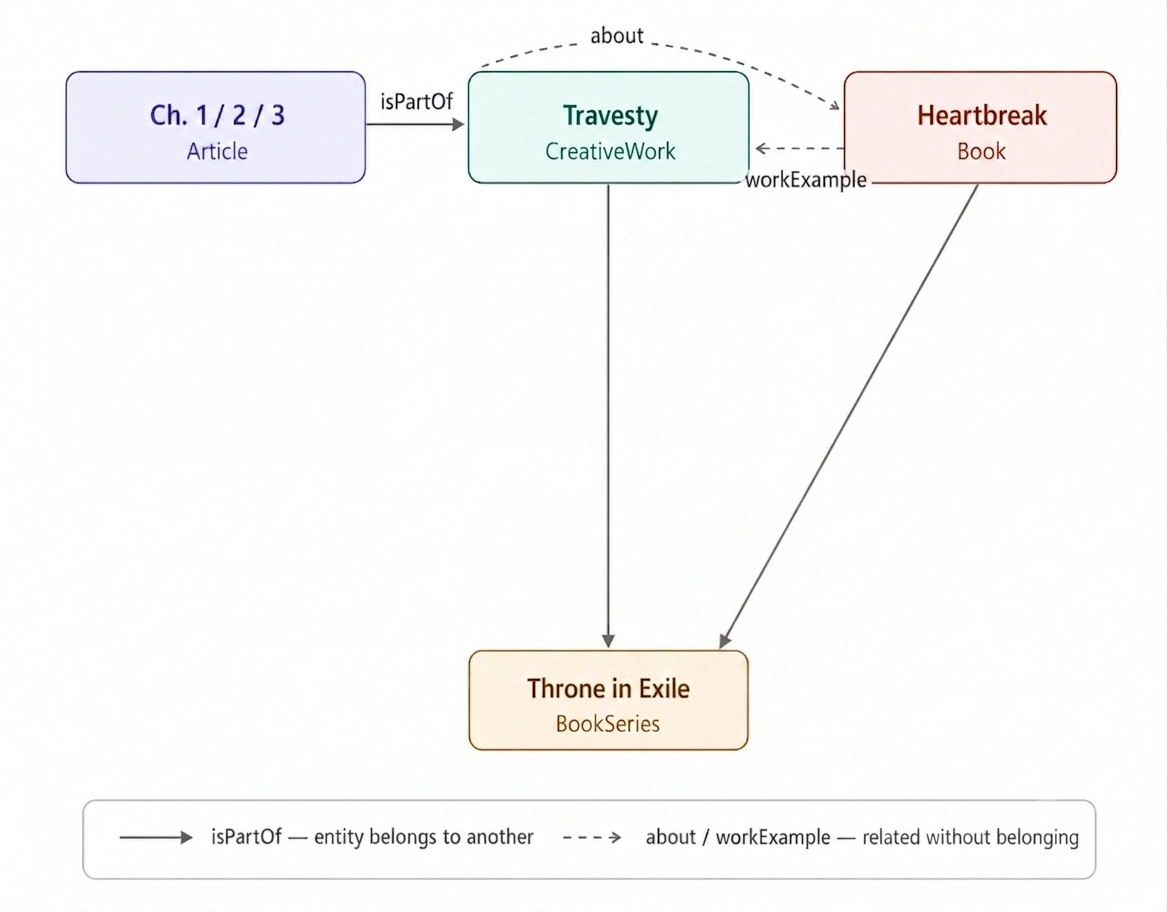 Relationships between Series, Book, and Chronicle Pages.